In Brief
The answer in under a minute.
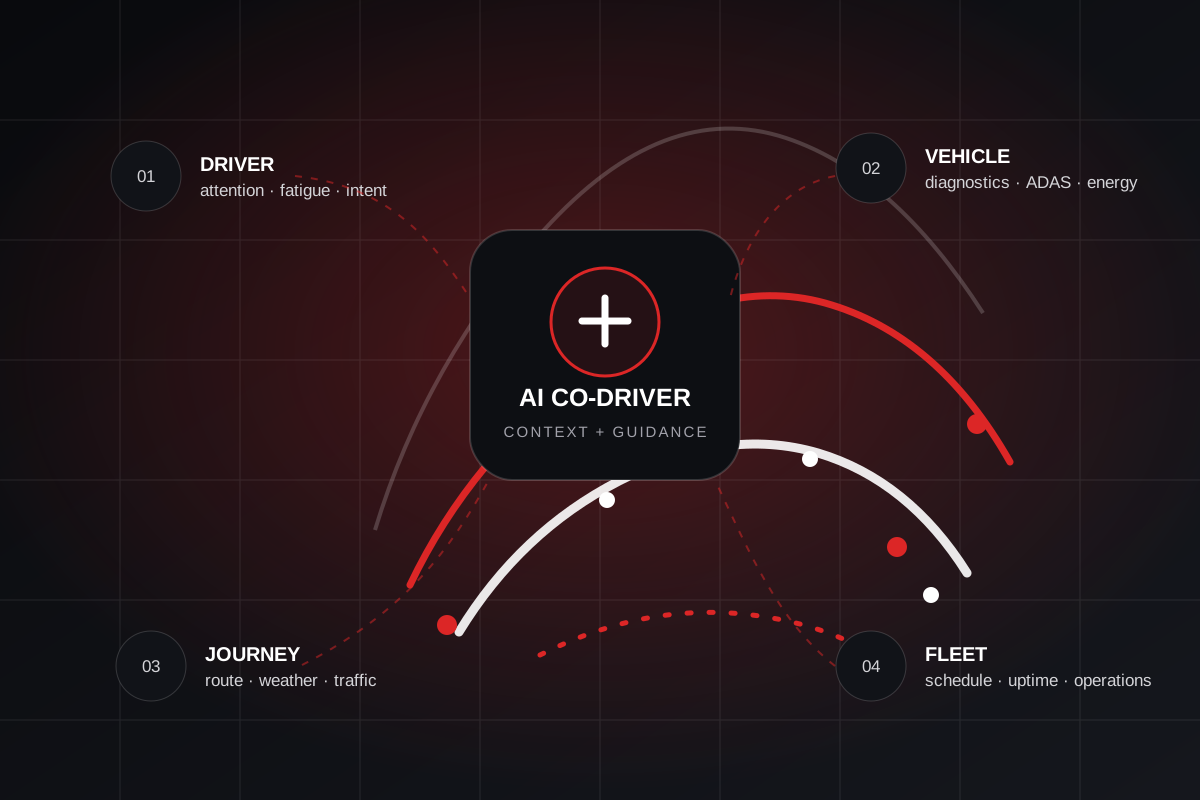
Artificial intelligence is unlikely to appear in commercial vehicles simply as a chatbot attached to the dashboard. The more credible path is an intelligence layer connecting driver monitoring, advanced driver assistance, connected vehicle data, predictive maintenance, navigation and fleet operations.
The commercial case could be compelling because fleets can measure outcomes such as incidents, fuel or energy use, uptime and productivity. But trust, privacy, cybersecurity, liability and automation complacency remain serious product challenges.
2032 · A shift begins
Before the truck moves, it already understands the load, route, weather, traffic, energy needs, maintenance state and the driver's available hours.
The driver is still driving. The truck is not autonomous. But the driver is no longer making every complex decision alone.
01
What exactly is an AI co-driver?
An AI co-driver is not necessarily an autonomous driving system. It does not mean the driver becomes a passenger, and it does not mean a large language model should receive unrestricted control over steering or braking.
Modern trucks already monitor lanes, detect hazards, transmit diagnostics, evaluate driving efficiency and increasingly monitor the driver. The opportunity is to connect those signals, understand context and communicate what matters at the right moment.
02
It is already arriving — in pieces
The future AI co-driver is unlikely to appear through one breakthrough. Driver monitoring, predictive driving, connected diagnostics, fleet telematics and increasingly natural-language vehicle interfaces are developing separately today.
Driver awareness
Eye movement, fatigue and distraction monitoring help the vehicle understand the state of the person operating it.
Predictive driving
Route and topography data allow the truck to anticipate conditions instead of reacting only to what is directly ahead.
Connected intelligence
Diagnostics, maintenance history and fleet data extend the vehicle's understanding beyond its onboard sensors.
Natural language
Conversational interfaces could translate complex vehicle data into clearer explanations and recommended actions.
03
Building the digital co-driver
Future Mobility Lab sees the product as five connected layers rather than a single application. That architecture also makes one important boundary explicit: generative intelligence can interpret and recommend without becoming an unrestricted safety controller.
System view
Driver + vehicle + journey + fleet
The co-driver is not one feature. It is an intelligence layer that connects several existing systems and presents the right information at the right moment.
Core outcome
Understand more. Predict earlier. Interrupt less.
Perception
Driver monitoring, road sensors, diagnostics, powertrain and load data.
Context
Route, traffic, weather, driving hours, fleet schedule and maintenance history.
Intelligence
Models identify patterns, risk, anomalies and the decisions that matter next.
Interaction
Alerts, coaching, recommendations and natural-language explanations.
Control boundaries
Validated vehicle systems retain authority over safety-critical actuation.
04
Why trucks are a compelling use case
Commercial transport creates unusually measurable reasons to adopt intelligent assistance. Fleets do not need AI because it is fashionable; they need lower risk, lower operating cost, better uptime and better-supported drivers.
AI co-driver
Intelligence translated into fleet outcomes
Safety
Fewer preventable incidents, lower operational risk and better driver-state awareness.
Efficiency
Smarter route, speed and energy decisions that can compound across a large fleet.
Uptime
Earlier interpretation of diagnostic signals and better maintenance prioritisation.
Driver support
Less cognitive load, clearer information and fewer unnecessary interruptions.
Fleet value
Lower risk · lower operating cost · better utilisation
FMCSA's 2025 methodology estimates the comprehensive cost of a large-truck crash at approximately $49,398 for a non-injury crash, $326,810 for an injury crash and $15.23 million for a fatal crash, in 2023 dollars. These are societal cost estimates rather than a direct fleet invoice, but they illustrate why safety improvements can have significant economic value.
The workforce case matters too. IRU's 2026 release of its 2025 driver-shortage research reports approximately 2.9 million unfilled truck-driver positions across 18 markets, while around 24% of Australia's driver workforce is expected to retire within five years.
05
The business case is a two-customer problem
The primary user is the driver, but the economic buyer will often be the fleet operator. Those two customers do not measure value in the same way.
Driver value
- Clearer information and fewer unnecessary alerts
- Better navigation and contextual support
- Reduced administrative and cognitive workload
- Assistance that feels supportive rather than intrusive
Fleet value
- Fewer incidents and lower operational risk
- Lower fuel or energy consumption
- Improved uptime and maintenance planning
- Better fleet visibility and operational coordination
The commercial model may also evolve as a software and connected-services layer rather than a one-time vehicle option: base safety systems, connected fleet services and then a higher-value intelligence layer combining predictive alerts, personalised recommendations and natural-language interaction.
The human problem
“The smarter the truck becomes, the more carefully the human-machine relationship must be designed.”
06
The danger of over-trust
Better assistance does not automatically produce safer behaviour. IIHS research found drivers engaged in distracting visual-manual activities more often while partial automation was active, and one study group was distracted for more than 30% of the time while using the system.
This creates a difficult product target. If assistance is too passive, it may fail to help. If it is too aggressive, drivers may ignore it. If it becomes highly capable, drivers may disengage. The goal should therefore be appropriate assistance rather than maximum automation.
07
What AI should — and shouldn't — control
Artificial intelligence can be extremely useful for interpreting complex information, identifying patterns, prioritising alerts, explaining vehicle behaviour and coordinating digital services.
But there is a fundamental difference between recommending a safer action and independently controlling a safety-critical system. Near-term AI co-drivers are more credible as intelligence and communication layers sitting above properly validated vehicle-control systems.
AI layer
Understand · explain · prioritise · recommend
Validated control layer
Sense · verify · intervene within certified boundaries
08
Product Analyst perspective
The product opportunity is not to add another screen to the cab. It is to turn fragmented information into useful interpretation at the moment a decision needs to be made.
Customer problem
Fleets face constant pressure to improve safety, cost, uptime and driver support while vehicles generate more data than humans can continuously interpret.
Product opportunity
Connect driver, vehicle, journey and fleet information into one context-aware assistance layer.
Commercial readiness
Strong enough to evolve incrementally through connected services, but fleets will demand measurable ROI.
Adoption barriers
Trust, privacy, cybersecurity, false alerts, connectivity, integration, liability, regulation and subscription cost.
09
Evidence today vs the FML forecast
To keep the analysis honest, it is important to separate systems that exist today from Future Mobility Lab's forecast of how they may converge over the next decade.
Evidence today · 2026
Future Mobility Lab forecast
Future Mobility Index
A strong opportunity because it can evolve from technology already in the vehicle.
The strongest case is not AI novelty. It is measurable customer value created by connecting existing safety, vehicle and fleet systems more intelligently.
Outlook · Strong
Verdict
Probably yes — but not as a chatbot sitting on the dashboard.
The more likely outcome is an increasingly invisible intelligence layer that understands the truck, driver, route and fleet, then predicts more, explains more, coordinates more and ideally interrupts less.
The truck may become intelligent long before it becomes autonomous.
Key Takeaways
The AI co-driver is more likely to emerge from existing systems than from one breakthrough product.
Commercial vehicles create a strong business case because safety, efficiency and uptime can be measured financially.
The fleet may be the economic buyer, but the driver remains the primary user—both must see value.
Human-machine interaction may be the hardest challenge: better automation can also encourage over-trust and distraction.
Near-term AI is best suited to understanding, explaining and recommending while validated systems retain safety-critical control.
The truck may become intelligent long before it becomes autonomous.
References
Public sources used in this analysis
This publication uses only public information. Future scenarios and product assessments are Future Mobility Lab analysis, not claims made by the organisations below.
Federal Motor Carrier Safety Administration
Crash Cost Methodology 2025
FMCSA methodology and 2023-dollar comprehensive crash-cost estimates for large trucks.
Open source
International Road Transport Union
Global Driver Shortage Report 2025
2026 release covering 2.9 million unfilled truck-driver positions across 18 markets and workforce ageing.
Open source
Insurance Institute for Highway Safety
Drivers quickly learn to skirt limits set by partial automation systems
Research examining distraction, complacency and behaviour while partial automation is active.
Open source
Bosch Mobility
AI-powered cockpit
Public concept describing contextual, natural-language vehicle interaction across in-vehicle and cloud functions.
Open source
Scania
Fuel efficiency technologies
Public information on predictive driving, driver feedback and efficiency-oriented vehicle systems.
Open source

Future Mobility Lab
Publication 002 · Version 1.0
Published 20 August 2026 · Written and analysed by Azhan Hassan
Independent product analysis based on public sources. Evidence today is separated from Future Mobility Lab forecasts throughout the publication.
Publication 003 · Planned
Hydrogen or Battery: What Will Power the Heavy Truck of the Future?
A product and infrastructure comparison of the two major zero-emission pathways competing for heavy commercial transport.
Future Mobility Lab is an independent publication. All views are personal, based on publicly available information, and do not represent any employer or organisation.